Overview of the 2025 North Sea cargo ships crash
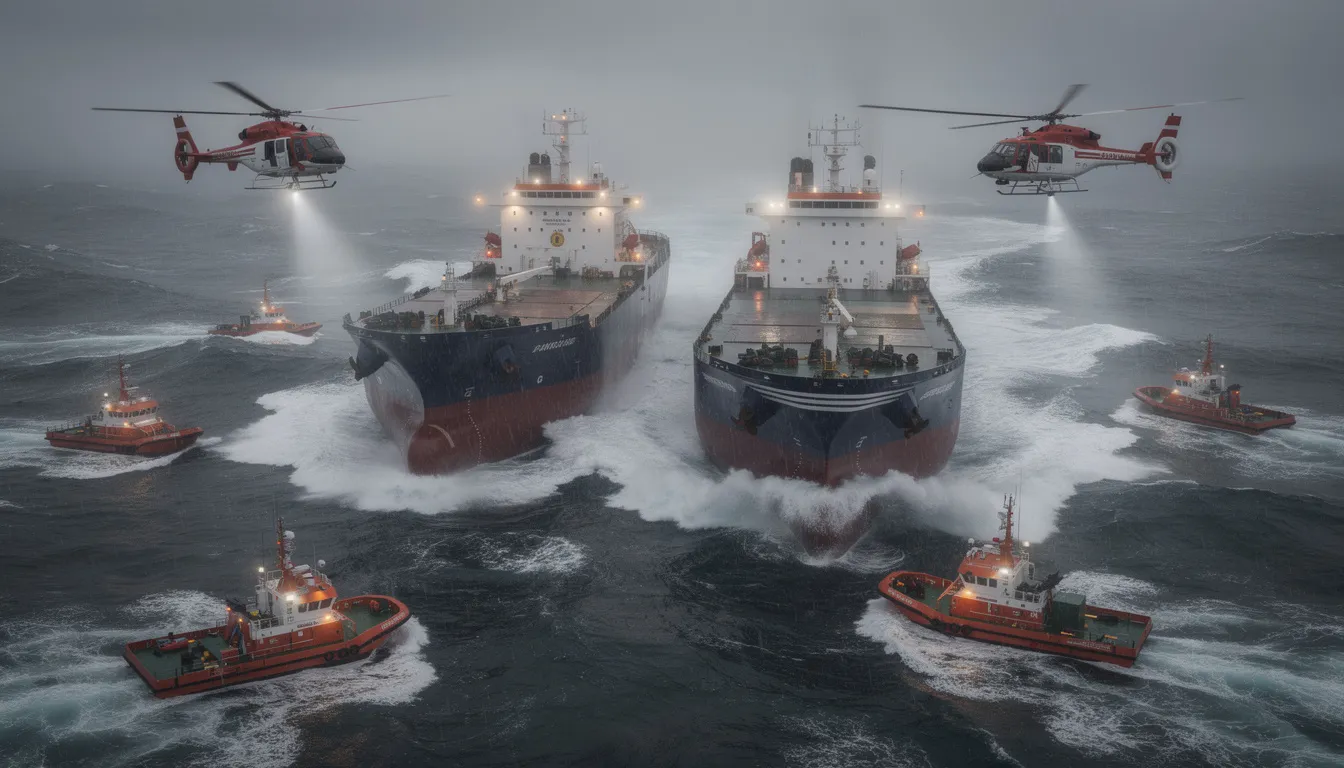
On the morning of Monday 10 March 2025, a collision between two vessels in the North Sea off East Yorkshire triggered one of the most serious maritime incidents in recent British waters. The Portuguese flagged container ship MV Solong struck the anchored US flagged tanker MV Stena Immaculate near Spurn Head, sparking multiple explosions and fires that would burn for more than a day.
The collision occurred at approximately 09:47 local time. MV Solong, a Portuguese cargo ship carrying containers of alcohol and materials previously used for transporting sodium cyanide, collided with the port side of MV Stena Immaculate, a 183-metre oil tanker carrying jet fuel destined for US military operations in Europe. The impact ruptured at least one cargo tank, igniting the aviation fuel aboard the tanker.
Thirty six people were rescued from the two ships in a massive rescue operation coordinated by HM Coastguard. However, one crew member from Solong remains missing and is presumed dead after the search for the missing was formally called off. The Russian captain of Solong, a 59-year-old Russian national, was arrested on suspicion of gross negligence manslaughter and remains subject to a criminal investigation.
Key facts at a glance:
| Detail | Information |
|---|---|
| Date of incident | 10 March 2025 |
| Time of collision | 09:47 GMT |
| Location | North Sea, off Spurn Head, East Yorkshire |
| Vessels involved | MV Solong (container ship), MV Stena Immaculate (oil tanker) |
| Crew on Solong | 14 (13 rescued, 1 missing) |
| Crew on Stena Immaculate | 23 (all rescued) |
| Cargo at risk | 220,000 barrels jet fuel, containers with sodium cyanide residue |
| Key agencies | Maritime and Coastguard Agency, Marine Accident Investigation Branch, Humberside Police |
Timeline of the collision and immediate rescue
The tragic incident began to unfold on the evening of 9 March 2025 when MV Stena Immaculate dropped anchor in the approaches to the Humber estuary. The US oil tanker, carrying jet fuel for the Defense Logistics Agency, was waiting for clearance to proceed to port. Throughout the night, the vessel remained stationary with its anchor lights displayed and AIS transponder broadcasting its position.
At 09:47 GMT on Monday morning, MV Solong—sailing south through the busy shipping lane—struck the anchored Stena Immaculate on her port side. The impact was catastrophic. Within moments, the collision ruptured the tanker’s hull, breaching at least one cargo tank. The jet fuel ignited almost immediately, triggering multiple explosions that sent thick black smoke billowing across the coast visible from shore.
Distress calls went out within minutes. The Coastguard Agency scrambled helicopters from Humberhead and dispatched RNLI lifeboats from Humber and Bridlington. Fire was spreading rapidly across both vessels. Rescue efforts focused first on evacuating crew members before the situation deteriorated further.
By mid-morning, 13 of the 14 Solong crew had been brought safely to shore, while all 23 crew members from Stena Immaculate were evacuated to Grimsby. One missing crew member from Solong—a Filipino national who had been working in the engine room—could not be located despite extensive search operations involving helicopters and surface vessels.
The incident remains ongoing triggered immediate port closures. Shipping traffic at Hull, Immingham, Goole, and Grimsby was suspended as emergency operations took priority. By late afternoon, authorities partially reopened the ports with restrictions as the immediate rescue phase concluded.
Key timeline points:
- 9 March, evening: Stena Immaculate anchors in Humber approaches
- 10 March, 09:47 GMT: Collision occurs; explosions and fire follow immediately
- 10 March, 10:15 GMT: Mayday received; HM Coastguard coordinates response
- 10 March, 11:30 GMT: First survivors brought ashore at Grimsby
- 10 March, 14:00 GMT: All 36 survivors confirmed evacuated
- 10 March, 16:00 GMT: Ports partially reopen with restrictions
- 11 March: Search for missing crew member suspended
The vessels involved: MV Solong and MV Stena Immaculate
MV Solong
The Portuguese flagged Solong is a mid-sized cargo vessel registered in Madeira and managed by the German logistics firm Ernst Russ. Designed for general container operations on North European routes, the ship regularly transited between Baltic and Atlantic ports carrying mixed commercial cargo.
At the time of the ship crash, Solong was transporting alcohol and a consignment of containers. Significant controversy surrounded reports that some containers aboard were carrying sodium cyanide—a highly toxic chemical used in industrial processes. Ernst Russ later clarified that four empty containers previously used for transporting the substance were on board, but disputed claims that they contained hazardous materials at the time of the collision.
MV Stena Immaculate
MV Stena Immaculate represents a different class of cargo vessel entirely. The 183-metre IMOIIMAX-class tanker operates under US flag, chartered by the logistics firm Crowley on behalf of the US military through the Tanker Security Program administered by the Defense Logistics Agency.
The tanker was carrying approximately 220,000 barrels of Jet A-1 aviation fuel in 16 segregated cargo tanks when the collision occurred. This fuel was destined for US Air Force and US Army operations across Europe—a critical component of NATO’s logistical infrastructure.
The vessel’s double-hull construction and compartmentalized tank design proved crucial in the aftermath of the collision. Despite significant damage to her port side and at least one breached cargo tank, Stena Immaculate remained able to remain afloat. The design features that prevent catastrophic hull failure allowed emergency responders precious time to evacuate crew and begin firefighting operations.

Crew, casualties, and human impact
The human toll of this cargo ship collision extends beyond simple casualty figures. Fourteen crew members served aboard Solong, including Russian and Filipino nationals. The tanker Stena Immaculate carried a complement of 23 American crew members.
Of the 37 people aboard the two vessels, 36 were brought ashore safely. All 23 Stena Immaculate crew reached Grimsby without serious injuries, though several required treatment for smoke inhalation and shock. Thirteen Solong crew members were similarly rescued, many having abandoned ship into life rafts before being picked up by RNLI lifeboats.
One Solong sailor—a Filipino national believed to have been working below decks at the time of impact—could not be located. Despite extensive search efforts involving coastguard helicopters and surface vessels operating through the night, authorities suspended the search on 11 March. The missing crew member is now presumed deceased.
Ernst Russ confirmed that the rescued Solong crew were interviewed and debriefed by authorities. The chief executive of the shipping firm stated that the arrested captain was cooperating fully with investigators. American crew from Stena Immaculate received consular support and temporary accommodation, with arrangements made for their repatriation to the United States in the days following the incident.
Human impact summary:
- 36 of 37 personnel rescued from both vessels
- 1 Filipino national from Solong presumed dead
- All 23 American crew from Stena Immaculate brought safely to Grimsby
- Crew treated for smoke inhalation, minor injuries, and trauma
- US consular support provided for Stena Immaculate crew
- Russian captain of Solong arrested and detained for questioning
Cargo, fire, and pollution risks
This cargo ships crash immediately raised fears of an environmental disaster along the East Yorkshire coast. The combination of a tanker carrying jet fuel and a container ship reportedly transporting toxic chemicals represented a worst-case scenario for marine pollution response teams.
Fuel hazards
The primary concern centred on Stena Immaculate’s cargo of approximately 220,000 barrels of Jet A-1 aviation fuel. When the collision breached at least one cargo tank, the released fuel ignited almost immediately. The resulting fire produced massive smoke plumes visible from tens of thousands of metres away on shore.
The saving grace, if one can call it that, was the nature of jet fuel itself. Unlike heavy bunker oil, which can persist in the marine environment for years, aviation fuel burns relatively quickly when ignited on the water surface. Much of the leaked fuel appears to have been consumed by the fire rather than spreading as a slick.
Chemical concerns
Reports that Solong was carrying sodium cyanide generated considerable alarm. Sodium cyanide is acutely toxic to marine life and humans alike—even small quantities can cause serious environmental damage. However, Ernst Russ clarified that the containers in question were largely or entirely empty units that had previously been used for plastic resin and other industrial materials.
Local MP Graham Stuart reported no evidence of heavy engine oil pollution in the water. Testing confirmed that no sodium cyanide was leaking from the containers aboard Solong.
Ongoing monitoring
Counter-pollution measures were deployed immediately. Oil collection booms and skimmers were staged at Grimsby, ready for deployment if significant quantities of fuel reached the surface. Continuous overflights monitored for slicks or chemical plumes, while water testing kits were deployed along the coast.
Risk assessment summary:
| Risk type | Status | Response |
|---|---|---|
| Jet fuel | Largely burned off at surface | Booms staged, aerial monitoring |
| Sodium cyanide | No leakage detected | Containers secured, testing ongoing |
| Heavy oil | Minimal evidence in water | Continued surveillance |
| Wreck contamination | Under assessment | Salvage planning underway |
Early monitoring suggested limited immediate environmental contamination, though authorities emphasised that long-term ecological studies would be necessary to assess the full impact.
Salvage efforts, port disruptions, and fate of the ships
Once the immediate rescue operation concluded, attention shifted to firefighting, stabilising the damaged hulls, and planning salvage operations for both vessels involved.
Drift and control
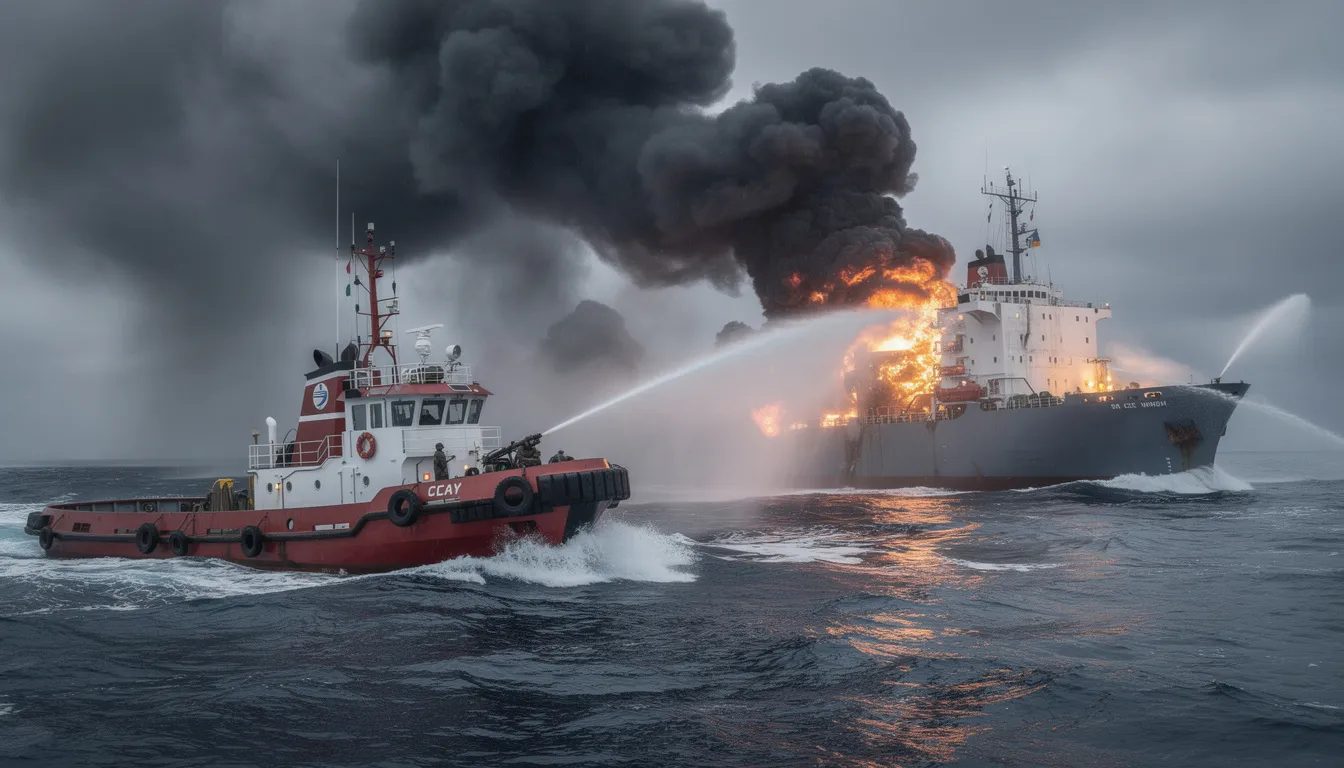
Overnight on 10-11 March, Solong separated from where it had become entangled with the anchored Stena Immaculate. The container ship drifted south for several hours, still ablaze, before a salvage company tug managed to secure a towline. Live helicopter footage broadcast across UK news channels showed water cannons spraying the burning vessel from multiple angles as crews fought to contain the fire on the ship’s deck and superstructure.
Stena Immaculate, though badly damaged, remained at anchor. Fire aboard the tanker was brought largely under control within a day, with visible flames extinguished while cooling operations continued. The vessel’s structural integrity, maintained by its double-hull design, meant it could remain afloat without immediate risk of sinking.
Port disruptions
The collision created significant disruptions for regional shipping. Traffic at Hull, Immingham, Goole, and Grimsby—collectively handling a substantial portion of UK east coast trade—was suspended on the morning of 10 March. Limited operations resumed by late afternoon, but restrictions remained in place as emergency response operations continued in the shipping lanes.
Transport Secretary Heidi Alexander stated that both ships were expected to remain afloat and could eventually be towed offshore for assessment. Earlier fears that Solong might capsize or sink proved unfounded, though the vessel sustained greatly reduced structural stability from the fire damage.
Salvage and logistics summary:
- Solong secured by tug after overnight drift
- Stena Immaculate remained at anchor position
- At least two salvage firms engaged for towage and firefighting
- Hull, Immingham, Goole, and Grimsby briefly closed then reopened with restrictions
- Both vessels expected to remain afloat pending damage assessment
- Decisions on repair or scrapping deferred to owners (Crowley, Ernst Russ)
Criminal investigation and legal consequences
Alongside the maritime safety investigation, a formal criminal investigation was launched by Humberside Police within hours of the collision. The law enforcement response reflects the severity of the incident and the loss of life involved.
Arrest and charges
A 59-year-old Russian national—identified as the captain of Solong—was arrested on suspicion of gross negligence manslaughter. The charge relates to the death of the missing crew member and the circumstances that allowed a moving cargo vessel to strike an anchored tanker in clear conditions.
The captain remained in police custody at Hull Magistrates Court jurisdiction for questioning in the days following the incident. Ernst Russ confirmed his role as master of the vessel but declined further comment, stating only that he was cooperating with authorities.
Gross negligence manslaughter
Under UK law, gross negligence manslaughter applies when a defendant’s breach of duty of care is so severe as to be characterised as criminal. In a maritime context, this might encompass failures in watchkeeping, navigation, or bridge resource management that fall below the standard expected of a competent seafarer.
Parallel investigations
The Marine Accident Investigation Branch opened a separate safety investigation running parallel to the criminal inquiry. MAIB investigators will examine navigational practices, bridge procedures, equipment functionality, and any communication failures that may have contributed to the collision.
The Maritime and Coastguard Agency coordinated the emergency response and continues to oversee vessel stability assessments. Political reactions included Hull City Council leader Mike Ross calling for an emergency Cobra meeting to address the incident’s severity.
The Prime Minister’s office stated there was no evidence of deliberate foul play, suggesting the collision appears to have been accidental rather than intentional.
Legal proceedings summary:
- Russian captain arrested on suspicion of gross negligence manslaughter
- Humberside Police leading criminal investigation
- Marine Accident Investigation Branch conducting parallel safety inquiry
- Maritime and Coastguard Agency overseeing vessel assessments
- No evidence of foul play according to government
- Investigation ongoing with no timeline for completion
Visual evidence and media coverage
The scale and visual drama of this cargo ship crash ensured extensive media coverage across UK broadcasters and international news outlets. Live helicopter footage became the defining imagery of the incident, shaping public understanding of the collision’s severity.
Broadcast coverage
Aerial images captured Solong’s charred bow and collapsed container stacks, providing stark evidence of the fire’s intensity. Water cannons spraying Stena Immaculate from emergency vessels created dramatic visuals that ran continuously on BBC and other channels throughout the day.
Journalists secured interviews with maritime safety experts, environmental scientists, and military logistics specialists. At least one American crew member from Stena Immaculate spoke to reporters after being brought ashore, describing the chaos of the collision and evacuation.
Tracking and transparency
Vessel-tracking websites using live AIS data allowed members of the public to follow Solong’s drift path in real time and observe the stationary position of Stena Immaculate near the mouth of the Humber. This transparency—enabled by modern maritime technology—meant the incident unfolded in public view, with armchair observers worldwide tracking developments as they happened.
Social media amplified both accurate information and speculation. Images of smoke plumes visible from the East Yorkshire coast spread rapidly, while rumours about toxic chemicals required official clarification from authorities and the vessels’ operators.
The visual record will prove valuable for investigators reconstructing the collision sequence and assessing the adequacy of emergency response protocols.
Broader implications: safety, military logistics, and environmental policy
Beyond the immediate human and environmental costs, this cargo ships crash exposes vulnerabilities in modern maritime operations that extend far beyond the North Sea.
Navigation and human factors
Modern shipping relies heavily on electronic navigation systems—AIS transponders, ECDIS displays, radar, and GPS. Yet this collision occurred in clear conditions with an anchored vessel broadcasting its position. The fundamental question investigators must answer is why a moving container ship struck a stationary tanker in a well-charted waterway.
Research into maritime casualties consistently identifies human factors—fatigue, distraction, complacency, and decision errors—as primary contributors to collisions. Studies of Yangtze River estuary incidents found that speed over ground significantly affects collision severity, with vessels travelling above 12 knots at much higher risk of severe outcomes. Bridge resource management failures, where multiple crew members fail to catch errors, compound individual mistakes.
Strategic logistics
Stena Immaculate’s role in the US Tanker Security Program highlights the collision’s geopolitical dimensions. The tanker was transporting fuel for US military operations in Europe—a critical component of NATO’s ability to project power and respond to crises. Incidents like this stress logistical planning and raise questions about the vulnerability of military supply chains operating through congested civilian shipping lanes.
The Defense Logistics Agency and US military will undoubtedly review protocols for fuel transport through high-traffic areas in light of this incident.
Environmental governance
Calls are already emerging for tighter routing measures in the approaches to major UK ports, more stringent hazardous cargo declarations, and improved emergency response capacity along the east coast. The proximity of this collision to shore—visible from the coast—underscores how quickly a marine accident can become a coastal emergency.
The North Sea collision stands as a stark reminder that even in an age of advanced navigation technology, human factors remain the critical variable in maritime safety. As investigations by the Marine Accident Investigation Branch and Humberside Police continue, the shipping industry, military logistics planners, and environmental regulators will be watching closely for findings that may reshape how vessels operate in congested waterways.
The lessons from this tragic incident—still unfolding as salvage operations continue and investigators piece together what went wrong—will likely influence maritime policy for years to come. For now, the priority remains determining exactly how this collision occurred and ensuring that those responsible are held accountable while preventing similar tragedies in the future.