
Every single day since November 7, 2000, at least one person has died on a Texas roadway. That’s more than two decades of daily fatalities—a grim streak that averages around ten deaths per day statewide. Whether you’re a driver involved in a collision, an insurance adjuster processing a claim, an attorney building a case, or a researcher studying traffic safety trends, understanding how to access Texas crash reports and data is essential.
This guide walks you through everything you need to know about obtaining crash records in Texas, navigating the official databases, and understanding the broader crash statistics that shape road safety policy across the state.
Immediate Answers: How to Get a Texas Crash Report Fast
If you’re reading this section first, you likely need answers now. Here’s what you need to know about getting your hands on a Texas crash report as quickly as possible.
The Texas Department of Transportation (TxDOT) serves as the official custodian of reportable crash records for all public roads and state highways across the state. This includes urban areas like Austin, Houston, Dallas, and San Antonio, as well as rural counties with farm-to-market roads and smaller highways.
What qualifies as a “reportable” crash? Under Texas Transportation Code §550.062, a crash must be reported if it involves injury, death, or apparent property damage of $1,000 or more. If your incident doesn’t meet this threshold, there may not be an official record in the system.
Texas peace officers must submit crash reports within 10 days of the crash date. This timing directly affects when you can purchase your report online—if you’re searching immediately after an accident, you may need to wait for the investigating officer to file the paperwork.
Regarding record retention, TxDOT keeps crash reports and related data for 10 years plus the current year. Crashes older than that timeframe are generally only available through historic annual statistics rather than individual reports. If you’re looking for a crash from 2012, for example, you may be out of luck for obtaining the specific CR-3 report.
One important note: TxDOT no longer retains or provides Driver’s Crash Reports (Form CR-2) submitted by motorists after 2019. These self-submitted forms are destroyed per records policy, so the peace officer’s report is your primary source for official documentation.
Texas Crash Reports and Records: What They Are and Who Maintains Them
The Texas Department of Transportation operates as the central repository for official crash records across the state. Understanding how this system works helps you navigate it more effectively.
CR-3 Reports: The Official Record
Texas Peace Officer’s Crash Reports are filed using the CR-3 form. These documents serve as the primary legal crash record used by insurers, attorneys, courts, and individuals seeking to understand what happened during a collision. When you hear someone reference “the crash report,” they’re almost always talking about this document.
These reports cover crashes on interstates like I-10, I-35, and I-45, as well as U.S. and state highways, farm-to-market roads, and most public streets maintained by cities and counties throughout Texas.
Investigating Agencies and Data Flow
Local agencies—including the Austin Police Department, Houston Police Department, Dallas PD, and county sheriff’s offices—investigate crashes within their jurisdictions. However, the final crash data flows into TxDOT’s Crash Records Information System (CRIS), which serves as the statewide database.
Here’s how the process works:
-
Reports can be amended by the investigating agency after initial submission
-
TxDOT retains both original and updated versions in the electronic database
-
The CRIS system allows for standardized data collection across all Texas jurisdictions
Other Crash Evidence
Crash records are distinct from other evidence types. TxDOT holds the report and data, but dash-cam videos, body-cam footage, photos, 911 audio recordings, and witness statements are typically maintained by the investigating law enforcement agency. If you need multimedia evidence beyond the written report, you’ll need to file a separate request with the responding agency.
Crash Report Online Purchase System in Texas
TxDOT’s Crash Report Online Purchase System provides the primary way for the public to buy a copy of a Texas Peace Officer’s Crash Report (CR-3). The process is straightforward once you understand what you need.
Searching for Your Report
To locate a specific crash report, you’ll typically need at least one of the following pieces of information: the crash ID number, the date of the crash, the name of a driver or person involved, or the investigating agency. Having multiple data points makes your search more likely to succeed, especially for common names or busy dates.
Who Can Order an Unredacted Report
Under Texas Transportation Code §550.065, specific categories of people can obtain unredacted reports:
|
Eligible Party |
Qualification |
|---|---|
|
Drivers and passengers |
Directly involved in the crash |
|
Vehicle owners |
Owner of a vehicle in the crash |
|
Insurance companies |
Processing a related claim |
|
Attorneys |
Representing an involved party |
|
Media organizations |
Reporting on the incident |
|
Governmental agencies |
Conducting official business |
People or entities not meeting one of these statutory categories will receive a redacted version. You may need to explain a “proper interest” to attempt to obtain additional information, though this doesn’t guarantee access.
What It Costs and How You Receive It
Purchased reports are typically delivered electronically as a PDF link via email, usually within minutes once payment is processed. Fees are set per report—commonly around $6 to $8—with a small credit card or online payment surcharge potentially added. Corporate accounts or bulk purchases may involve additional processing fees.
Crash Data Requests, Bulk Data, and the CRIS Query Tools
For users who need more than a single crash report—researchers, safety professionals, journalists, attorneys, and public agencies—TxDOT offers expanded access to crash data.
Online Request Form
TxDOT provides an online Crash Data Request Form where users can request bulk crash IDs, large datasets, and specialized extracts for defined time ranges. For example, you might request all fatal crashes on I-35 in Bexar County from January 1, 2018, through December 31, 2023. These requests require you to specify precise parameters to avoid processing delays.
CRIS Query Tool
The Crash Records Information System Query Tool functions as a web-based search interface that lets the public query crash data using various filters. You can search by county, city, roadway, crash type, contributing factors, and date ranges. This tool is particularly useful for identifying patterns—such as multiple crashes at a specific intersection or a spike in crashes during particular months.
Annual Data Extracts
TxDOT publishes annual reports and standardized data extracts for those who need statewide totals, trend analysis, and comparative statistics spanning multiple years. These resources are invaluable for grant applications, policy papers, and safety campaign development.
Complex or high-volume bulk requests naturally take longer to fulfill. Being specific about what you need—and why—helps TxDOT staff process your request efficiently.
Crash Reports vs. Crash Data: Key Differences
A crash report (CR-3) documents a single incident in detail, including the parties involved, the responding officer’s narrative, and the circumstances of the collision. Crash data, on the other hand, refers to large sets of records used for analysis and statistical purposes.
Crash reports are individually purchased and contain identifying details like names, addresses, and insurance information. Crash data is typically aggregated and anonymized to comply with privacy requirements while still providing valuable information such as crash location, severity, weather conditions, and contributing factors.
If you’re filing an insurance claim or pursuing a lawsuit, you need the crash report. If you’re researching the rise in distracted-driving crashes from 2010 to 2024 or identifying dangerous corridors in your county, you need crash data.
Subpoenas, Affidavits, and Legal Requests for Texas Crash Records
In civil lawsuits stemming from collisions on busy routes like I-10, I-35, or Beltway 8, attorneys often need to formally subpoena crash records. Texas Transportation Code §550.065 governs how crash reports can be released in response to legal requests, and TxDOT processes these through its online CRIS Request system.
Effective January 1, 2025, TxDOT will no longer accept mailed requests for crash reports and will not require the CR-91 form. All requests move to the online portal, streamlining the process for legal professionals.
The basic steps involve uploading the subpoena or affidavit, paying the standard $8 crash report fee plus applicable surcharges, and monitoring your email for confirmation, status updates, and download links.
TxDOT only provides crash reports and related record data. Any request for dash-cam or body-cam video, on-scene photographs, or witness statements must go to the investigating agency—whether that’s Texas DPS, a county sheriff’s office, or a city police department.
To avoid processing delays, attorneys and insurers should ensure their legal documents clearly identify the crash by date, specific location (such as “I-10 westbound at Trinity River Bridge in Chambers County”), and the names of involved parties to prevent common mistakes during the accident claims process.
Crash Data Analysis, Statistics, and the Traffic Safety Data Portal
TxDOT maintains a statewide automated database of motor vehicle crashes, using this information to track safety trends and guide roadway improvements. The data informs everything from signal timing adjustments to major highway reconstruction projects.
The TxDOT Traffic Safety Data Portal serves as an online platform offering interactive charts, dashboards, and maps for crash data across Texas—from dense urban centers to remote rural counties. Users can explore information across seven emphasis areas:
-
Impaired Driving
-
Distracted Driving
-
Speeding
-
Failure to Use Seat Belts
-
Motorcycle Safety
-
Pedestrian Safety
-
Bicycle Safety
The portal allows you to view statewide trends—comparing fatal crashes involving impaired driving in 2020 versus 2023, for instance—or zoom in on specific regions and corridors where your community or organization focuses its efforts.
For registered users, the CRIS Query interface provides deeper access to crash-level information for custom queries. The portal is designed for both professionals and the general public, with downloadable charts and data that can support grant applications, safety campaigns, and policy presentations.
TxDOT’s Vision: “End the Streak” and the Road to Zero
For more than two decades, Texas has recorded at least one roadway death every single day. The state averages approximately ten fatalities per day, a toll that reflects high traffic volumes, extensive rural road networks, and persistent behavioral factors like speeding and impaired driving.
TxDOT’s “End the Streak” messaging represents the agency’s effort to raise awareness about this daily tragedy. The broader Road to Zero vision sets ambitious goals: ending all traffic fatalities on Texas roads by 2050 and cutting fatal crashes in half by 2035.
Crash data directly informs these efforts. Patterns in nighttime crashes, impaired driving incidents, and seat belt non-use guide funding for specific safety projects and public awareness campaigns. TxDOT coordinates with metropolitan planning organizations in cities like Austin, San Antonio, Houston, and Dallas–Fort Worth to identify high-crash corridors and prioritize safety improvements.
The goal isn’t just collecting data—it’s using that data to save lives.
Annual Texas Motor Vehicle Crash Statistics (2003–2024)
TxDOT publishes official annual Texas Motor Vehicle Crash Statistics reports summarizing each calendar year. These documents provide the most authoritative look at crashes, injuries, and fatalities across the state.
Cumulative statewide statistics are available online for the years 2003 through 2024, including totals for crashes, injuries, and fatalities, with breakdowns by roadway type and primary contributing factors. The most recent full-year estimate showed Texas reporting 4,283 deaths with 294.785 billion vehicle miles traveled—yielding a fatality rate of 1.45 deaths per 100 million miles, which exceeds safer benchmarks in other states.
These annual reports contain charts and tables showing trends in areas like:
-
Alcohol-related crashes over time
-
Distracted driving incidents and their growth
-
Rural vs. urban fatality distributions
-
Motorcycle crashes by year and region
Policymakers, advocacy groups, media outlets, and researchers rely on these annual statistics to measure the impact of new laws, enforcement campaigns, and engineering changes. For example, pedestrian fatalities climbed 22% between 2019 and 2023, reaching 914 deaths statewide. Cyclist deaths surged 58% over the same period.
Readers can use this information to compare local crash experience to statewide trends, identify emerging risks in their communities, and support safety grant proposals with concrete evidence.
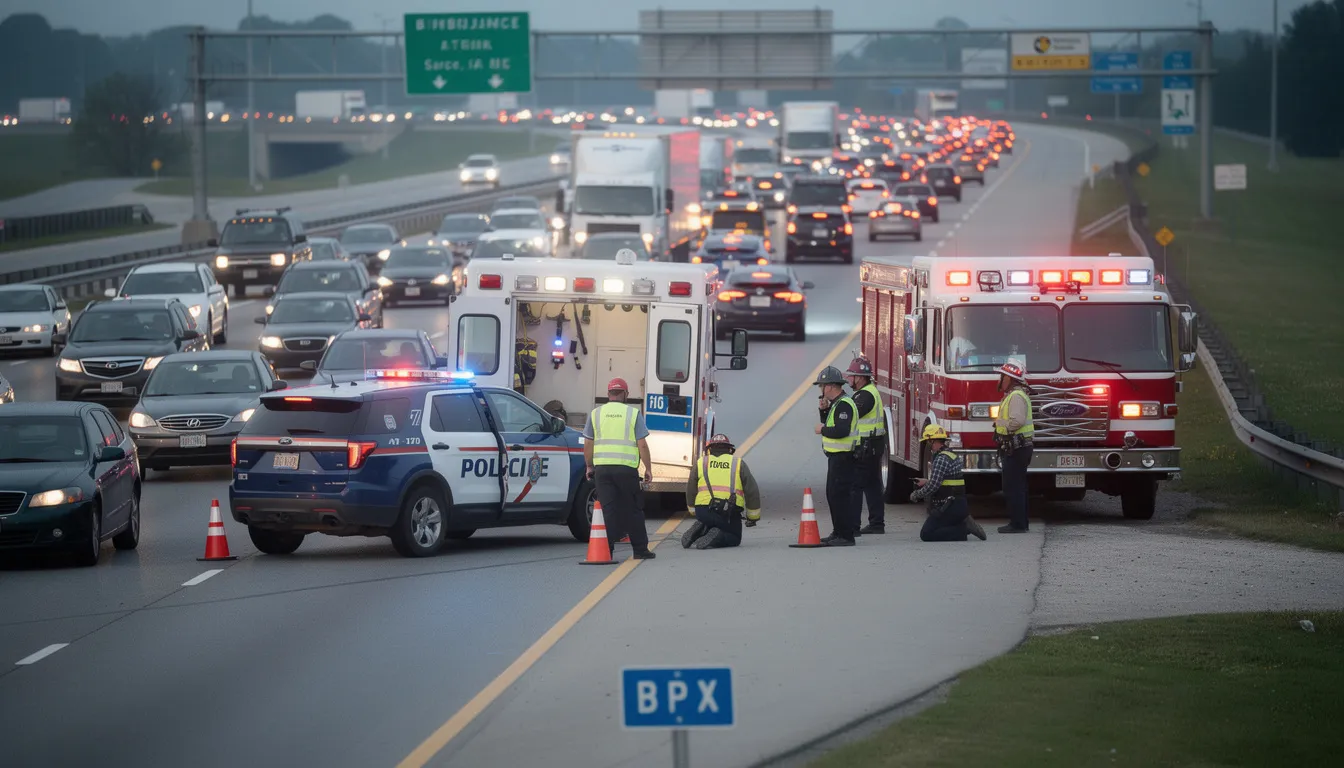
Texas Accidents on I-10: Recent Multi-Crash Events and Weather Hazards
Interstate 10 stretches across Texas from El Paso to the Louisiana border, passing through some of the state’s most heavily trafficked corridors. When conditions deteriorate, the result can be catastrophic chain-reaction collisions that tie up traffic for hours.
On a recent sunday morning, multiple crashes occurred on I-10 westbound near the Trinity River Bridge in Chambers County. Dense Gulf Coast fog reduced visibility to near-zero in places, and drivers traveling at highway speeds found themselves suddenly confronting stopped or slow-moving vehicles. The result was heavy damage and extended traffic delays that stretched for miles.
The Chambers County Sheriff’s Office and Texas Department of Public Safety (DPS) troopers responded together, working to secure the scene, assist any injured motorists, and clear damaged vehicles from the roadway. Officials warned drivers to expect significant delays, advising them to slow down, use headlights even during daytime, and increase following distance in foggy or low-visibility conditions.
Westbound lanes were eventually reopened later that morning, but authorities continued investigating the crashes to determine contributing factors such as weather, speed, and driver inattention. These incidents illustrate how a single morning can generate multiple crashes that ripple through the official statistics and cause major transportation disruptions.
How Fog, Rain, and Congestion Drive Crash Spikes on Texas Highways
Weather conditions like dense Gulf Coast fog, heavy rain, and sudden storms contribute significantly to multi-vehicle crashes on busy highways throughout the state. I-10, I-35, and I-45 all see seasonal spikes in crashes tied to weather events.
Traffic congestion near major interchanges and river crossings—such as the Trinity River Bridge—creates additional risk. When vehicles in the front of a traffic queue slow suddenly, drivers behind may not have enough time or distance to react, triggering rear-end collisions and chain-reaction pileups.
TxDOT and law enforcement use historical crash data to identify weather-sensitive segments. Responses may include activating dynamic message signs warning of conditions ahead, implementing temporary speed management, and deploying targeted enforcement during high-risk periods.
For drivers, the advice remains consistent: adapt speed to current conditions, maintain longer following distances than normal, and avoid distractions like phones or navigation systems during challenging weather. These behaviors directly reduce the likelihood of becoming part of a multi-car crash.

Local Crash Datasets: Example from Austin, Texas
Beyond statewide TxDOT data, some Texas cities publish their own open datasets tied back to TxDOT’s CRIS crash records. These local resources can be invaluable for community-level safety analysis.
The “Austin Crash Report Data – Crash Level Records” dataset includes crash-level information for incidents within Austin’s Full Purpose city limits over the last ten years. The source of this local dataset is TxDOT’s CRIS system, populated by Texas Peace Officer crash reports submitted by agencies including the Austin Police Department.
Due to reporting and verification timelines, Austin’s open data usually includes crashes that are at least two weeks old. If you’re searching for a very recent incident, it may not yet appear in the public dataset.
The dataset is updated periodically, though there is no detailed public changelog of structural updates or field changes. Users should verify data freshness before drawing conclusions for time-sensitive projects.
Local planners, journalists, advocacy groups, and residents can use city-level crash datasets to:
|
Use Case |
Application |
|---|---|
|
Identify problem intersections |
Prioritize safety improvements |
|
Evaluate speed reduction projects |
Measure before-and-after crash rates |
|
Support Vision Zero strategies |
Build evidence-based policy recommendations |
|
Track neighborhood safety trends |
Inform community advocacy efforts |
Austin’s dataset exemplifies how local governments can make crash information accessible to the public while maintaining consistency with the broader statewide framework.
Key Takeaways
Understanding accidents in Texas requires navigating official systems, interpreting data, and knowing where to find the information you need. Here’s what to remember:
-
TxDOT is your primary source for official crash reports and statewide crash data, maintaining records for 10 years plus the current year
-
The online purchase system provides fast access to individual CR-3 reports, typically delivered via email within minutes
-
Bulk data requests and the CRIS Query Tool serve researchers, attorneys, and safety professionals who need more than a single report
-
Legal requests are transitioning fully online as of January 2025, streamlining the subpoena process
-
Annual statistics document trends over time, helping identify emerging risks and measure the impact of safety interventions
-
Local datasets like Austin’s complement statewide data, enabling community-level analysis
Texas continues to lead the nation in roadway fatalities, with every day since November 2000 claiming at least one life. Whether you’re handling the aftermath of a personal collision, researching traffic safety for professional purposes, or advocating for safer streets in your community, the crash records and data systems maintained by TxDOT put critical information at your fingertips.
Take the time to familiarize yourself with these resources before you need them. When the unexpected happens on Texas roadways, knowing how to access official records quickly can make a meaningful difference in your insurance claim, legal case, or safety research.