Every year, thousands of Texans walk away from a car crash thinking the hard part is over-only to discover that the real fight starts when the medical bills arrive and the insurance company pushes back. If you or someone you love has been injured in a car wreck anywhere in Texas, this guide breaks down exactly what a car accident lawyer does, why timing matters, and how to position yourself for fair compensation instead of a lowball check.
Key Takeaways
Here is a quick summary for anyone who has just been through a car wreck in Texas. The situation is stressful, but taking the right steps now protects your rights later.
-
After any car accident in Texas-whether in Houston, Dallas, San Antonio, or a rural county-the at fault driver’s insurance company will immediately work to limit payouts. Calling an experienced car accident lawyer quickly is one of the most important things you can do.
-
A lawyer for a car wreck can help immediately with medical referrals, evidence preservation (photos, dash cam, black-box data), and dealing with insurance adjusters so you avoid statement traps and lowball offers.
-
The Morgan Legal Group and InjuredCases.com focus on serious car accident injury claims across Texas and offer free consultations and free case evaluations with no fees unless compensation is recovered.
-
Texas has a strict statute of limitations-generally two years from the crash date-plus shorter internal insurance deadlines, so injury victims should not wait to get legal advice.

Why Texas Car Wreck Victims Turn to a Lawyer for Help
Modern motor vehicle accidents on Texas highways-I-45 through Houston, I-35 near Austin, Loop 410 in San Antonio-routinely turn into complex legal and medical problems. Even after what seems like a minor car accident, injury victims quickly face hospital bills from facilities like Houston Methodist or Baylor Scott & White, missed paychecks, and a steady stream of confusing calls from multiple insurance adjusters. Many accident victims don’t realize the scope of the problem until they are already behind.
Texas is a fault-based state, which means proving the other driver’s negligence is crucial to obtaining fair compensation. Among the most frequent causes of car accidents are distracted driving, which causes about 25% of car accidents, aggressive driving, and driving under the influence, which leads to thousands of fatalities annually. Poor road conditions and inexperienced drivers also contribute to many collisions. You may have a claim if another driver caused the crash through any of these behaviors, but building that claim takes evidence, documentation, and legal knowledge.
A dedicated car accident lawyer coordinates investigations, medical documentation, and negotiations, allowing clients to focus on recovery instead of paperwork and arguments with insurers. The Morgan Legal Group handles serious auto accident and industrial injury cases across Texas, and its car accident legal services help victims navigate claims from initial investigation through settlement or trial. InjuredCases.com connects victims with qualified personal injury attorneys who are ready to act quickly on their behalf. It is advisable to speak with a lawyer if significant injuries or disputed fault arise after an accident.
What a Car Wreck Lawyer Actually Does for You
Think of this section as a plain-language roadmap of how a car accident lawyer adds value from day one through settlement or trial. A lawyer handling a car accident case acts as a legal advocate, investigator, and negotiator-often all at once.
-
Case evaluation: The attorney reviews police crash reports, EMS run sheets, and early medical records, then explains Texas car accident laws and your options in a clear strategy session.
-
Investigation: Tasks include obtaining traffic camera footage from an intersection, 911 recordings, phone records in suspected distracted driving cases, and vehicle black-box (EDR) downloads. Hiring a lawyer helps gather crucial evidence that would otherwise be lost. Complex injury cases may require resources like medical experts or accident reconstruction specialists.
-
Claim building: The lawyer calculates economic damages-ER bills, imaging, surgery, physical therapy, lost wages-and non-economic damages such as pain and suffering, loss of enjoyment of life, and PTSD. This applies to both major and minor car accident injuries.
-
Negotiations: A car accident lawyer manages communications with insurance companies on behalf of clients, starting with a written demand letter, then counteroffers, and mediation if needed. This keeps you from saying something that could be used against your car accident claim.
-
Litigation and trial: If insurers refuse a fair settlement, the attorney files a car accident lawsuit in the correct Texas county and handles discovery, depositions, expert witnesses, and jury presentation. Finding a lawyer with trial readiness is essential because most car accident cases settle out of court, but some must go to trial if negotiations fail.
Common Car Accident Injuries After a Texas Wreck
Common car accident injuries often don’t reveal their full impact in the first 24–72 hours, which is why early medical care and documentation are vital for both health and any future personal injury claims. Emergency care pathways-ambulance to facilities like Memorial Hermann in Houston or University Hospital in San Antonio-generate records that become key evidence in car accident cases.
-
Soft tissue injuries: Soft tissue injuries like sprains and strains are common in car accidents. Whiplash commonly occurs in rear-end collisions, causing neck pain, stiffness, and headaches. Insurers tend to downplay these injuries despite significant physical pain and missed work.
-
Concussions and traumatic brain injury: Traumatic brain injuries can occur even in minor collisions. Delayed symptoms-memory gaps, concentration problems, mood changes-can dramatically affect a car accident lawsuit’s trajectory and long-term care needs.
-
Spinal cord injuries and herniated discs: Herniated discs can result from the impact of a car crash, causing radiating pain that may require injections or surgery. For heavy-labor workers in Texas industries, these injuries can end careers.
-
Broken bones and orthopedic injuries: Car accidents can cause broken bones requiring extensive medical care, hardware placement, and months of physical therapy. Visible injuries like casts and scars often help establish damages, but recovery timelines can be long.
-
Internal injuries: Internal injuries from blunt force trauma often require immediate intervention. “Feeling fine” at the accident scene can be misleading-CT scans and follow-up care are critical for both survival and claim value.
-
Psychological trauma: Emotional distress, anxiety driving on interstates, nightmares, and depression are legitimate car accident injuries. A good car accident lawyer helps include mental health treatment costs in compensation demands.

What to Do Immediately After a Car Wreck in Texas
These are practical safety and legal-protection steps for crashes occurring anywhere in Texas-on city streets, highways, or rural FM roads. Evidence can disappear quickly, so act fast after an accident.
-
Prioritize safety. Move to a safe location if possible, turn on hazard lights, and call 911 to request police and EMS-even for a minor collision. Note any damaged traffic signs or road hazards.
-
Get a police report. Request law enforcement-Houston Police Department, Harris County Sheriff’s Office, or Texas DPS troopers-so a formal crash report is generated. Documentation like police reports is essential for filing a claim.
-
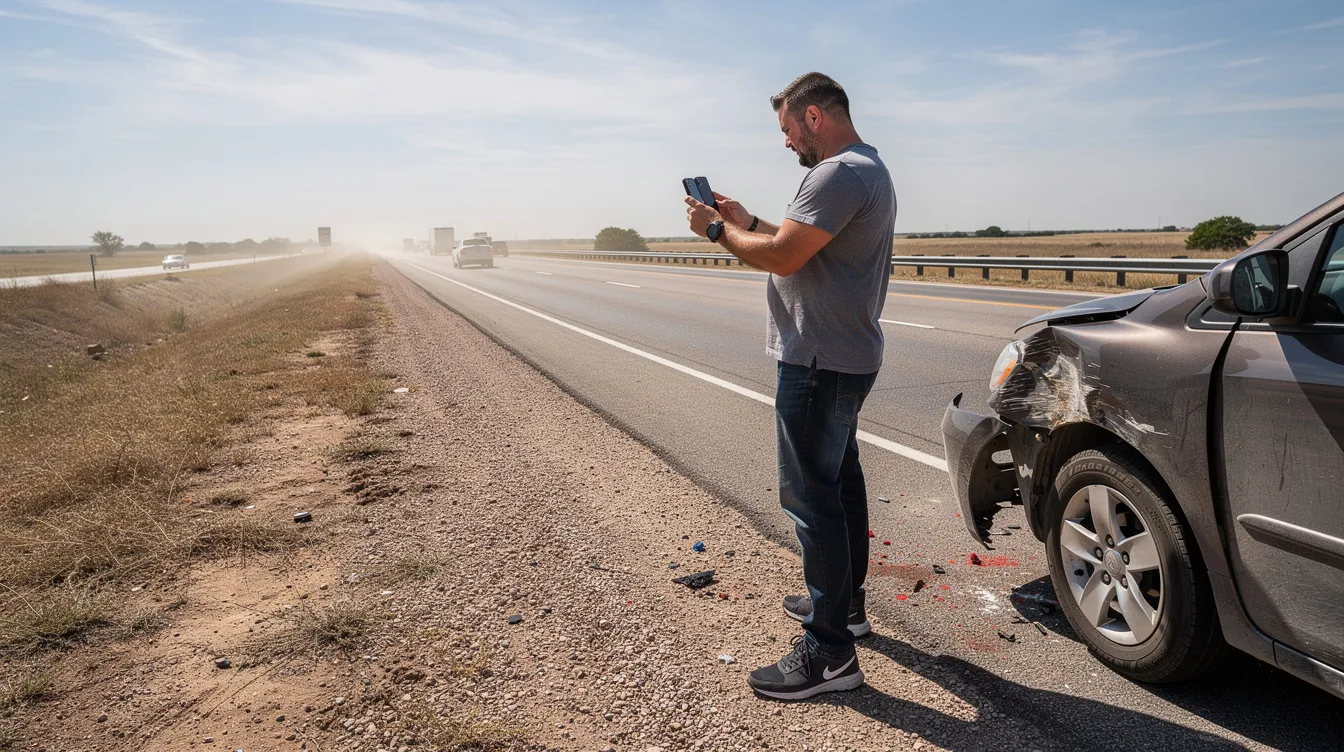
Collect evidence at the accident scene. Take photos of all vehicles, skid marks, road conditions, traffic signals, weather, and any visible injuries. Capture license plates and exchange driver’s license and insurance information with the other driver. A valid claim requires evidence like police reports or witness statements, so gather witness statements if bystanders saw the accident happened.
-
Limit conversation. Do not apologize or argue about fault with the other driver. Give only necessary facts to the police officer for the official report.
-
Seek prompt medical treatment. Visit the ER, urgent care, or your primary doctor the same day-even if pain seems minor. Keep copies of every medical record and bill. Delayed treatment can undermine a personal injury lawsuit later.
-
Contact a Texas car accident lawyer. Reach out for a free case evaluation before speaking to any insurance adjuster or signing documents.
How Insurance Companies Handle Car Wreck Claims
In most Texas auto accident cases, the at fault driver’s insurance company opens a claim file within 24–48 hours and immediately looks for ways to minimize payout. Insurance companies aim to minimize payouts to maximize profits-this is not speculation, it is their business model. Insurance companies often minimize payouts to injured victims, especially those without legal representation.
-
The adjuster’s role: Insurance adjusters are trained to protect the company’s interests. They call for a recorded statement, ask about prior injuries, and suggest that the car crash was minor to downplay pain. Adjusters may contact you while you’re still in pain and your understanding of the severity of your car accident injuries is incomplete.
-
Common tactics: Requesting broad medical authorizations, disputing medical treatment as “unnecessary,” claiming pre-existing conditions, and blaming delays in care to reduce the value of your insurance claim.
-
Lowball offers: Early settlement offers sometimes arrive within days of a wreck, particularly when common car accident injuries like whiplash or concussions are present but not fully diagnosed. Insurance companies often offer quick settlements before full medical understanding of the injuries exists.
-
Delay strategies: Slow responses, repeated document requests, and “file review” excuses are intended to wear down accident victims financially and emotionally. Insurance companies often assign higher fault percentages to victims to justify lower payouts.
-
How a lawyer counters this: An experienced car accident lawyer handles all communication, sets clear deadlines, and prepares a case as if trial will be necessary. This changes the dynamic entirely.
Recorded Statements, Quick Offers, and Other Traps
There is no legal requirement in Texas to give a recorded statement to the other driver’s insurer, and doing so without counsel can severely damage your car accident claim.
-
Statement dangers: Recorded statements lock in downplayed symptoms, “I’m okay” comments, or guesses about speed and fault that can later be twisted to argue against fair compensation. Even an innocent comment can be taken out of context months later.
-
Early settlement checks: Quick offers often arrive before MRI results or specialist evaluations. Signing a release permanently ends the right to pursue additional money-even if surgery is needed later. They often offer quick settlements before full medical understanding exists.
-
Route everything through your lawyer: Injured victims should direct all adjuster contact through their car wreck lawyer, who provides accurate updates while preventing common mistakes or unnecessary disclosures.
-
Real-world example: In a 2025 rear-end collision in Houston, an injured driver received a first-week offer of $8,500. After surgery for a herniated disc months later, the actual medical expenses alone exceeded $95,000. Accepting that early check would have left tens of thousands of dollars on the table.
-
Social media caution: Do not post about the crash or injuries online. Insurers increasingly monitor social media for photos, check-ins, or comments that contradict claims of pain and suffering in car accident lawsuits.
Car Accident Laws and Statute of Limitations in Texas
Texas follows an at-fault (tort) system for auto accidents, meaning car accident laws govern who pays, how fault is measured, and how long car accident victims have to file personal injury claims. Understanding these rules is essential before you file a car accident lawsuit.
-
Modified comparative negligence: Texas’s proportionate responsibility rule means injury victims can recover compensation if they are not more than 50% at fault, but their compensation is reduced by their percentage of fault. If you are found 51% or more responsible, recovery is barred entirely under Tex. Civ. Prac. & Rem. Code § 33.001.
-
Minimum insurance coverage: Texas law requires drivers to carry at least 30/60/25 liability insurance coverage-$30,000 bodily injury per person, $60,000 per accident, and $25,000 for property damage per the Texas Motor Vehicle Safety Responsibility Act. These limits are often inadequate for severe injuries.
-
Statute of limitations: Under Tex. Civil Practice & Remedies Code § 16.003, the statute of limitations for Texas personal injury claims is generally two years from the date the accident occurred. A wrongful death claim also carries a two-year deadline from the date of death. Missing this window usually bars filing a personal injury lawsuit permanently. For comparison, Missouri’s statute of limitations is five years for personal injury claims, North Carolina requires a three-year statute of limitations for car accident claims, South Carolina also has a three-year window, and Alabama has a two-year statute of limitations for car accident lawsuits.
-
Government entity deadlines: If a city truck, school bus, or TxDOT vehicle is involved, you must file a claim within 90 days if a government entity is involved-a much shorter window that catches many people off guard.
-
Why early legal advice matters: Consulting a lawyer for a car wreck as early as possible helps ensure all deadlines are met, evidence is preserved, and the claims process isn’t rushed at the last minute.
How Much Is My Car Accident Lawsuit Worth?
There is no fixed calculator for a car accident lawsuit’s value in Texas. Every case depends on the facts, and a car accident claim depends heavily on the severity of injuries and long-term impact. Compensation varies based on injury severity and evidence strength.
-
Economic damages: These are documented costs-ambulance rides, ER visits, hospital stays, surgery, medication, rehab, medical bills lost income, reduced earning capacity, and property damage. You can seek compensation for medical bills after an accident, and lost wages can be claimed if you miss work due to injuries. Future medical expenses are also calculated for ongoing care needs. Injured victims can recover costs for long-term care needs when injuries are permanent.
-
Non-economic damages: Compensation may include pain and suffering damages, emotional distress, loss of enjoyment of life, scarring, and loss of consortium for spouses. Texas does not cap non-economic damages in car wreck cases (unlike medical malpractice).
-
Punitive damages: In rare cases involving gross negligence-like a drunk driver causing a catastrophic crash on I-10-punitive damages may be available to punish extreme misconduct.
-
What drives value up or down: Age, occupation, pre-existing conditions, and whether injuries are permanent (such as spinal cord damage or traumatic brain injury) all influence car accident settlements. Car accident lawyers calculate total damages including lost wages and pain based on these and other factors.
-
Real examples: A Collin County jury awarded $482,764 to a 22-year-old with disc herniations and $114,000 in past medical bills. A McKinney teacher struck by a red-light runner recovered $1,600,000 for head injuries and spinal herniations. A Parker County jury awarded $5,200,000 after a wrong-way interstate collision caused a below-knee amputation. Routine soft-tissue cases may settle for tens of thousands.
-
Expert support: An experienced car accident attorney uses medical experts, economists, and life-care planners when needed to document full lifetime losses before entering serious negotiation.

What If the Other Driver Has No Insurance or Not Enough Coverage?
Texas roads include many uninsured and underinsured drivers, and this is a frequent problem in serious car accident cases. When the at fault driver cannot cover your damages, other options exist.
-
Uninsured motorist coverage (UM): This coverage on your own insurance policy steps in when the at fault driver carries no liability insurance at all. It can cover medical expenses, lost wages, and pain and suffering up to your policy limits.
-
Underinsured motorist coverage (UIM): UIM applies when the other driver’s insurance coverage is too low to fully compensate your losses. Together, UM and UIM provide a critical safety net.
-
Not mandatory, but must be offered: While UM/UIM is not strictly required in Texas, insurers must offer it in writing. If there is no valid written rejection on file, courts have ruled that the coverage remains part of the policy. Many drivers carry at least some protection without realizing it.
-
Finding hidden coverage: A lawyer for a car wreck reviews every potentially applicable policy-the victim’s own, household members’, and employer-provided policies-to find all available insurance coverage.
-
Making a UM/UIM claim: The injured party must prove the other driver’s fault and the full amount of damages before the policy pays out. The legal process mirrors a liability claim in many ways.
-
Hit-and-run accidents: These may still be covered under uninsured motorist coverage, provided the incident is promptly reported to police and the insurer, and evidence such as witness statements or camera footage is preserved.
Minor Car Accidents Can Lead to Major Problems
Picture this: a low-speed rear-end collision at a Houston stoplight on a routine commute. Both bumpers look fine. The other driver apologizes. You feel a little sore but nothing alarming. Three days later, you can’t turn your neck, headaches won’t stop, and shooting pain runs down your arm.
-
Bumper damage does not equal injury risk. Soft tissue and spinal injuries can be serious and persistent even when vehicles show minimal exterior damage. A motor vehicle collision at 15 mph can generate enough force for a herniated disc.
-
The “low impact” trap. Insurance companies routinely label crashes as “low impact” to justify denying imaging, specialist referrals, or higher car accident settlements. This tactic is designed to close the injury claim cheaply.
-
Seek medical evaluation immediately. Even if symptoms are mild on day one, follow up with recommended medical treatment. Gaps in care give insurers ammunition to argue your car accident injuries were not caused by the crash.
-
Report every symptom. Tell doctors about every ache, headache, or change in mood so medical records accurately document the progression of the injury. What feels minor today could indicate a serious problem.
-
Take “small” claims seriously. A car accident lawyer can prevent quick, undervalued settlements that ignore long-term pain and treatment needs, helping you seek compensation that actually reflects your losses.
Choosing the Right Lawyer for a Car Wreck in Texas
There is no single “best car accident lawyer” for every situation, but there are clear criteria Texas car wreck victims can use to find the right fit.
-
Look for focus, not generalists. Choose personal injury lawyers who concentrate on auto accident cases-attorneys who rarely litigate motor vehicle collisions will not have the negotiation leverage or courtroom experience your case may need.
-
Evaluate real results. Review case results, client testimonials, and the types of accidents handled. Reviewing client testimonials can help gauge a lawyer’s reputation and effectiveness. Experience with similar injuries and fact patterns-18-wheeler crashes on I-20, multi-vehicle pileups, commercial vehicle collisions-matters.
-
Demand direct attorney access. Direct access to your attorney rather than support staff is important for effective communication. A good lawyer should prioritize clear communication with clients throughout the legal process, providing regular updates and honest assessments.
-
Understand the fee structure. Reputable firms, including The Morgan Legal Group, work on a contingency fee basis and charge no upfront fees. Understanding the fee percentage and calculation methods is essential before hiring a lawyer.
-
Vet through trusted platforms. InjuredCases.com connects Texas injury victims with vetted car accident attorneys who meet strict criteria for responsiveness, compliance, and experience handling serious personal injury claims.
Working with The Morgan Legal Group and InjuredCases.com
The Morgan Legal Group is a Houston personal injury law firm focused on high-impact car accident, truck accident, and industrial injury cases. InjuredCases.com is the legal marketing platform that connects car accident victims with qualified counsel-quickly and compliantly.
-
Investigative depth: Founding attorney Clinton Morgan brings over 15 years of hands-on experience investigating serious industrial, oil and gas, and wind-energy accidents. That firm background and mission translate directly to building stronger car accident and auto accident claims, especially where liability is disputed or evidence is technical.
-
Statewide reach: The firm handles cases throughout Texas-Houston, Dallas–Fort Worth, San Antonio, Austin, the Permian Basin, and coastal counties-often involving catastrophic injuries, spinal cord injuries, and wrongful death, supported by a wide range of personal injury practice areas.
-
Client-centered approach: Clients receive direct access to attorneys, clear explanations of each stage of their car accident lawsuit, and case strategies tailored to their medical, financial, and family needs, reflected in strong client reviews and testimonials.
-
No-risk fee structure: The firm operates on a contingency fee basis-attorneys work on a contingency fee basis, meaning no upfront costs. Their FAQ on personal injury representation explains how contingency fees work in more detail. Free consultations and free case evaluations are available to injury victims and families.
-
Behind the scenes: InjuredCases.com uses compliant, real-time lead delivery to ensure injured Texans are connected quickly with lawyers ready to act on tight statute of limitations and evidence-preservation deadlines. Many accident victims find their way to experienced counsel through this platform.
How Long Does a Car Accident Claim or Lawsuit Take?
Timelines vary widely, from a few months for straightforward personal injury claims to several years for complex, high-value car accident lawsuits. Patience and a clear strategy both matter.
-
Initial phase (first 30–90 days): Medical stabilization, investigation, gathering the police report and witness statements, and notifying insurers. This is the foundation of every injury claim, especially in complex serious accident and trucking cases.
-
Maximum Medical Improvement (MMI): Doctors need time to reasonably predict recovery and future needs before serious settlement talks can begin. For significant car accident injuries, this often takes 6–18 months.
-
Negotiations: Once a demand package is submitted, insurers review medical records, request clarification, and exchange offers and counteroffers. This phase can take weeks or months depending on the complexity of the car accident claims the firm handles and the auto accident cases involved.
-
Litigation: If settlement fails and a lawsuit is filed in a Texas district court, discovery, motions, mediation, and trial settings can add 12–24 months, depending on county docket backlogs. Liable parties may use every procedural tool available to delay.
-
Balancing speed and value: A good lawyer for a car wreck will balance the client’s need for timely funds with the goal of full and fair compensation, clearly explaining trade-offs between a quick resolution and a maximized outcome, especially if you need a car accident attorney in Houston.
Free Consultations, Fees, and What It Costs to Hire a Car Accident Lawyer
Most reputable Texas car accident lawyers, including The Morgan Legal Group, offer free consultations and work on a contingency fee basis. Free initial consultations are commonly offered by personal injury lawyers across the state, so there is no financial barrier to getting answers about your legal options.
-
What happens during a free case evaluation: The attorney reviews the crash facts, takes a preliminary look at available insurance coverage, discusses your injuries and medical treatment, and gives honest feedback about next steps-all at no charge.
-
How contingency fees work: The lawyer advances case costs-medical records, expert fees, filing fees-and receives a percentage of the settlement or verdict only if money is recovered. Attorneys work on a contingency fee basis, meaning no upfront costs for the client.
-
Zero out-of-pocket risk: Clients generally owe nothing up front and nothing for attorney’s fees if there is no recovery, making legal help accessible even to families under severe financial stress from medical bills lost income, and mounting expenses.
-
Represented vs. unrepresented outcomes: Studies consistently show that legal representation increases settlement amounts by 300%. Even after attorney’s fees, experienced representation often results in higher net compensation than going it alone. Victims with legal representation receive higher settlements than unrepresented ones. Personal injury lawyers can help maximize compensation for medical bills and pain and suffering.
-
Ask the right questions: Before signing a retainer, ask about fee percentages, cost deductions, and how liens-like health insurance or hospital liens-will be handled so you understand exactly how much you may take home.
Frequently Asked Questions About Hiring a Lawyer for a Car Wreck
This FAQ covers common concerns that Texas drivers dealing with car wrecks in 2024–2026 may have, including questions not fully addressed in the sections above.
Do I need a lawyer if the car accident was clearly not my fault?
Clear fault on paper does not guarantee fair compensation. Insurance companies often minimize payouts without legal representation by disputing the necessity of medical treatment, the extent of your car accident injuries, or the amount of lost wages you are claiming. An experienced car accident lawyer helps quantify all damages-including future medical expenses and long-term care-and pushes back against attempts to blame some part of the injury on pre-existing conditions. Even in seemingly straightforward motor vehicle collision cases, having counsel ensures the compensation you deserve is actually pursued and documented.
How soon after a Texas car accident should I call a lawyer?
Contact a car accident lawyer as soon as you have received initial medical treatment-ideally within the first few days after the accident occurred. Evidence can disappear quickly: traffic camera footage may be overwritten, witnesses move, and memories fade. Early legal involvement ensures evidence preservation, manages insurance communications, and tracks critical statute of limitations deadlines. That said, it is still worthwhile to call weeks or months later. Delayed contact can make it harder to recover video footage or counter arguments about gaps in treatment, but a strong case can still be built.
What if I already started talking to the insurance company without a lawyer?
You can still hire counsel even if you have already reported the insurance claim or given a brief statement. Your new lawyer will take over all future communication and can review any past statements for potential issues, correct misunderstandings through written submissions, and prevent further damaging disclosures. Many car accident victims begin the claims process on their own before realizing they need professional help-experienced car accident attorneys handle this transition routinely.
Can I change lawyers in the middle of my car accident case?
Clients generally have the right to change law firms if communication is poor or confidence has been lost. Successor counsel will usually work out fee-sharing arrangements with the original firm without additional cost to the client. Before making a switch, review your retainer agreement and schedule a consultation with the new lawyer to understand how the transition would work in your particular Texas case. The goal is always to have a legal team that fights for fair settlement results and keeps you informed every step of the way.
What if I was partially at fault for the car wreck?
Texas’s modified comparative negligence rule means you can often still recover compensation even if you were partially responsible. If your fault is 50% or less, you can seek compensation, but your award will be reduced by your share of responsibility. For example, if you suffered injuries worth $100,000 and were found 20% at fault, your recovery would be $80,000. Insurance companies often assign higher fault percentages to victims, so having a car accident lawyer gather evidence-witness statements, accident scene analysis, vehicle damage patterns-can significantly affect the final outcome. Do not accept the insurer’s fault determination without legal review.
If you or a loved one has been injured in a car wreck in Texas, do not wait for the insurance company to dictate the outcome. Contact The Morgan Legal Group today for a free case evaluation. There are no upfront fees, no financial risk, and no obligation-just honest answers about your rights and the compensation you may be entitled to recover. Visit InjuredCases.com or call now to speak directly with an experienced attorney who is ready to fight for you.