Texas highways are among the most dangerous in the nation for truck accidents, with over 730 people killed in large truck crashes in 2023 alone—more than any other state. The vast network of interstate highways, booming freight industry, and oil and gas operations create a perfect storm of factors that contribute to devastating collisions involving 18-wheelers and other commercial vehicles.
Understanding the causes, consequences, and legal implications of texas truck accident cases is crucial for anyone who travels Texas roads or has been affected by these tragic events. This comprehensive guide examines recent major accidents, explores common causes, and provides essential information about legal rights and remedies available to victims and their families.

Overview of Texas Truck Accidents
Texas leads the nation in truck accident fatalities with over 400 deaths annually according to Federal Motor Carrier Safety Administration data. In 2023, the state recorded 730 deaths from large truck crashes—nearly double California’s 392 deaths and more than twice Florida’s 341 fatalities. These sobering statistics reflect not just Texas’s large size and population, but also systemic issues within the commercial trucking industry and enforcement gaps that allow dangerous carriers to continue operating.
Interstate highways like I-35, I-20, I-45, and US-281 see the highest concentration of commercial vehicle crashes. The I-35 corridor stretching from Dallas through Austin to San Antonio carries enormous freight volumes, while I-20 serves as a major east-west artery through Dallas and into West Texas oil regions. I-45 connects the massive Houston port complex with Dallas, creating one of the nation’s busiest truck corridors.
Major trucking corridors through Dallas, Houston, Austin, and San Antonio experience frequent 18-wheeler accidents due to dense traffic mixing passenger cars with heavy commercial vehicles. Harris County alone recorded 7,750 accidents involving large trucks in 2021, with 2,181 collisions causing injuries and 44 fatal truck accidents. The combination of urban congestion, construction zones, and high-speed traffic creates particularly dangerous conditions for all motorists.
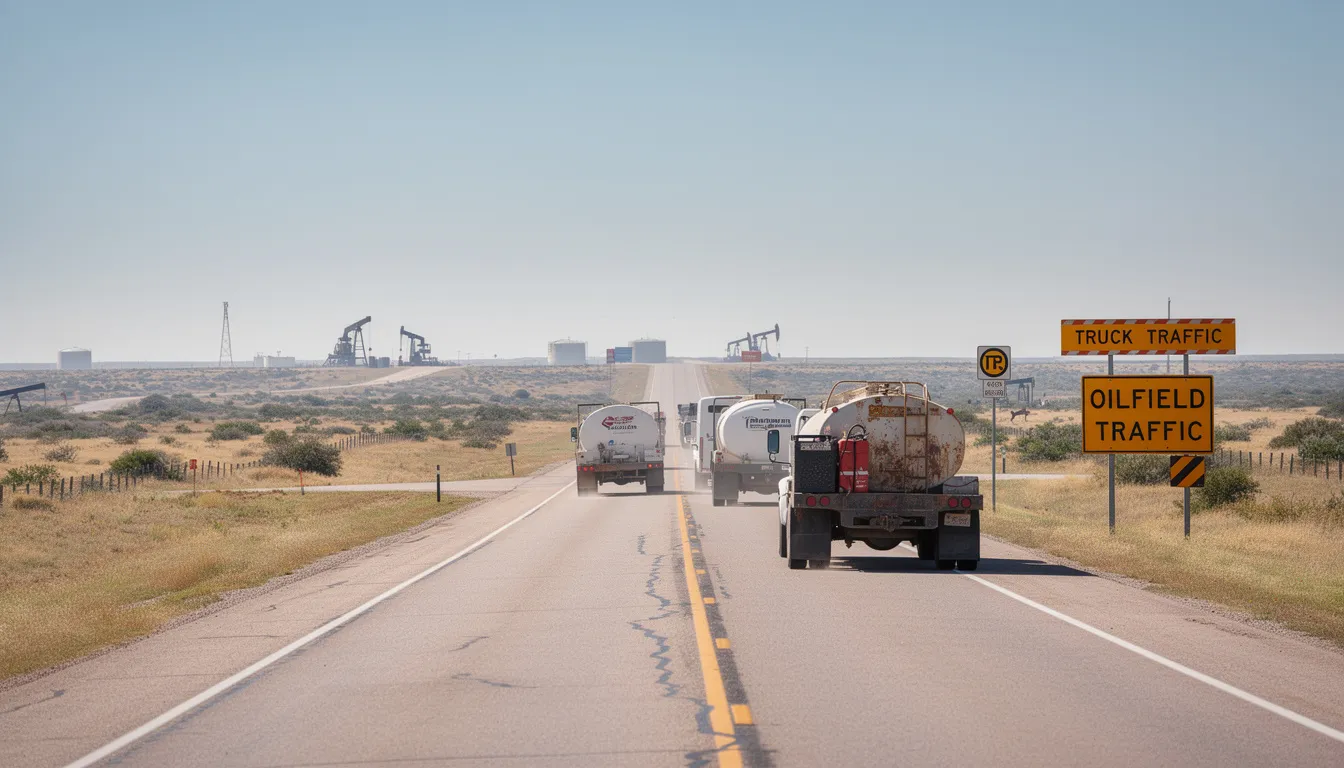
Oil and gas industry traffic in areas like Midland and the Permian Basin contributes to increased truck accident rates. The Texas Department of Public Safety has documented how the energy boom has supercharged commercial vehicle traffic on rural roads never designed for such heavy volumes. These thin, two-lane highways now carry intense flows of tanker trucks, sand haulers, and other specialized equipment, leading to devastating head-on collisions and rollover crashes.
Recent Major Texas Truck Accidents
Construction Zone Accidents
One of the most tragic recent examples occurred in March 2025 when a tractor trailer hauling an Amazon shipment triggered a 17-vehicle pileup in a construction zone near Austin, killing five people including two children. The crash highlighted the extreme dangers that construction zones pose when commercial drivers fail to adjust their speed and following distance for changed traffic patterns.
The Interstate 20 Kaufman County crash in June 2025 demonstrated how driver fatigue and systemic safety violations can lead to catastrophic results. Alexis Gonzalez Companioni, driving for Hope Trans LLC, fell asleep at the wheel while hauling U.S. mail and plowed through a construction zone without applying the brakes. The crash killed five people, including four members of one family who were pronounced dead at the scene.
Investigators discovered that Hope Trans LLC had a documented history of hours-of-service violations, maintenance neglect, and fraudulent vehicle registration. The company failed more than one-third of its vehicle inspections over two years, and drivers were repeatedly cited for falsifying their service records. Despite these red flags, reduced federal enforcement allowed the dangerous trucking company to continue operating until this devastating major accident occurred.
Construction zones create additional hazards for commercial vehicles due to reduced lane widths, concrete barriers, and sudden speed reductions. When a fully loaded tractor trailer enters a work zone at highway speeds, the massive kinetic energy requires much greater stopping distances than passenger cars. Even brief moments of inattention or fatigue can transform a routine traffic slowdown into a multi-vehicle catastrophe.
Rural Highway Crashes
The challenges of rural highway truck accidents became apparent in a fatal collision near Hico on US-281, where three semi trucks were involved in a chain-reaction crash that left two people dead. The accident highlighted how rural highways with limited shoulders and two-way traffic create particularly dangerous conditions when multiple vehicles lose control or fail to maintain proper following distances.
Rural crashes often involve longer emergency response times, as first responders may be located dozens of miles from accident scenes. When critically injured passengers require immediate medical attention, these delays can mean the difference between life and death. The Texas Department of Public Safety has documented how some crash victims have waited over an hour for ambulances to reach remote accident locations.
Farm-to-Market road accidents involving oil field tankers have become increasingly common as energy companies move equipment and materials between well sites. These specialized vehicles often carry hazardous materials and operate on roads with minimal safety infrastructure. When accidents occur involving chemical tankers or other hazmat loads, the resulting fires and toxic exposures can affect entire communities.
Solomun Weldekeal Araya’s case represents another tragic example of how impaired driving by commercial drivers can devastate multiple families. Field sobriety tests conducted after his crash revealed central nervous system depressant use, leading to serious criminal charges including multiple counts of manslaughter.
Common Causes of Texas Truck Accidents
Understanding why texas truck accident cases occur requires examining both driver-related factors and environmental conditions that contribute to these devastating collisions. The National Transportation Safety Board and texas dps have identified several recurring patterns in their investigations of fatal crashes involving commercial vehicles.
Driver-Related Factors
Driver fatigue from violating Hours of Service regulations enforced by Federal Motor Carrier Safety Administration represents one of the leading causes of serious truck accidents. Commercial drivers are legally limited to 11 hours of driving after 10 consecutive hours off duty, with a 14-hour on-duty window and mandatory 30-minute breaks. However, the Kaufman County investigation revealed how some drivers and companies systematically falsify these records to maximize profits.
The Texas Department of Public Safety findings show that falling asleep at the wheel contributes to a significant percentage of fatal crashes. In the I-20 incident, Alexis Osmani Gonzalez Companioni never applied the brakes before plowing into stopped traffic, indicating complete loss of consciousness. Investigators noted that proper rest periods could have prevented this tragedy that claimed five people’s lives.
Distracted driving including texting, phone calls, and electronic device usage has become an epidemic among truck drivers. Unlike passenger car drivers, commercial operators handle 80,000-pound vehicles that require constant attention and quick reaction times. Even a few seconds of distraction while checking a cell phone can result in traveling hundreds of feet without watching the road.
Impaired driving by central nervous system depressants, alcohol, or illegal substances violates both federal regulations and texas department of public safety standards. Commercial drivers face much stricter impairment thresholds than regular motorists, with career-ending consequences for positive drug tests. However, enforcement gaps and inadequate testing have allowed some impaired drivers to continue operating until catastrophic accidents occur.
Poor vehicle maintenance and mechanical failures in commercial fleets represent another major risk factor. The Hope Trans LLC case revealed how systematic maintenance neglect—including failed inspections on over one-third of vehicles—can create rolling death traps on Texas highways. Brake failures, tire blowouts, and steering problems are particularly dangerous when they occur in heavy commercial vehicles at highway speeds.
Environmental and Road Factors
Weather conditions including Texas thunderstorms, fog, and high winds create additional challenges for truck drivers who must control vehicles with high centers of gravity and extended stopping distances. Flash flooding is particularly dangerous for heavy trucks, as their weight can cause them to lose traction or become trapped in water that would not stop passenger cars.
Construction zones and road conditions contribute to accidents when drivers fail to adjust for changed traffic patterns, reduced speeds, and narrow lanes. The texas dps has documented how work zones create bottlenecks where passenger cars and commercial vehicles are forced into close proximity with concrete barriers and limited escape routes.
The challenges specific to Texas oil field traffic and heavy industrial trucking include overloaded vehicles, inadequate road maintenance, and mixing local traffic with heavy industrial equipment. Many Farm-to-Market roads were never designed for the massive trucks now serving drilling operations, creating dangerous conditions for all drivers.
What to Do After a Texas Truck Accident
The moments and hours following a texas truck accident are crucial for protecting both your health and legal rights. The complexity of commercial vehicle crashes requires specific steps that differ significantly from typical car accidents.
Seek immediate medical attention even if injuries seem minor. The massive forces involved in truck accidents can cause internal injuries, brain trauma, and spinal damage that may not be immediately apparent. Adrenaline and shock can mask serious injuries that become life-threatening if left untreated. Emergency responders are trained to recognize signs of hidden trauma that accident victims might not notice.
Ensure Texas Department of Public Safety or local police investigate and file official report. Unlike minor fender-benders, truck accidents typically require professional investigation due to their complexity and potential for serious injuries. The investigating officer will document the scene, interview witnesses, and create an official crash report that becomes crucial evidence in any legal proceedings.
Document the accident scene with photos of vehicles, road conditions, and injuries. Use your phone to capture multiple angles of the vehicles involved, any skid marks or debris, traffic signals or signs, and the general road conditions. These photos can preserve critical evidence that may be altered or destroyed before a thorough investigation can take place.
Collect contact information from truck driver, witnesses, and other involved parties. Obtain the commercial driver’s license information, their employer’s name and insurance details, and the truck’s license plate and DOT number. Witness statements can provide crucial third-party perspectives on how the accident occurred, especially if the truck driver claims a different version of events.
Contact experienced Texas truck accident attorney within 24-48 hours. Commercial vehicle cases involve federal regulations, complex insurance policies, and corporate defendants with teams of lawyers. Having skilled legal representation from the beginning helps ensure that critical evidence is preserved and your rights are protected throughout the process.
Evidence Collection
The importance of preserving truck driver logs and Hours of Service records cannot be overstated in building a strong legal case. Electronic logging devices (ELDs) in modern trucks automatically record driving hours, but this data can be lost or overwritten if not preserved quickly. Your attorney can send spoliation letters requiring the trucking company to maintain all relevant records.
Electronic logging devices and black box data can prove negligence by showing exactly what the truck was doing in the moments before the crash. This includes speed, braking, steering input, and whether the driver was following federal safety regulations. The data from these devices often contradicts the stories told by truck drivers and their employers.
Trucking company maintenance records and driver qualification files reveal patterns of negligence that may have contributed to the accident. Companies are required to maintain detailed records of vehicle inspections, repairs, driver training, and drug testing results. These documents often show whether the company prioritized profits over safety.
Medical Documentation
Documenting injuries from truck accidents requires more comprehensive medical evaluation than typical car crashes. The massive forces involved can cause complex trauma affecting multiple body systems. Emergency room physicians may focus on immediate life-threatening injuries while missing other significant damage that becomes apparent days or weeks later.
Following through with medical treatment plans is essential both for your recovery and for your legal case. Insurance companies will argue that any gaps in treatment indicate your injuries were not serious. Consistent medical care creates a clear record showing how the accident has affected your life and what ongoing treatment you need.
Specialized trauma care for truck accident victims often involves multiple medical specialists working together to address complex injuries. This might include orthopedic surgeons for broken bones, neurologists for brain injuries, and psychologists for post-traumatic stress. The coordination and cost of this care can quickly reach hundreds of thousands of dollars.

Legal Aspects and Criminal Charges
Texas law provides multiple avenues for holding negligent truck drivers and their employers accountable for the devastating consequences of commercial vehicle accidents. Both criminal prosecution and civil litigation play important roles in seeking justice for victims and their families.
Criminal Prosecution
When truck drivers show reckless disregard for safety that results in deaths, Texas prosecutors can pursue serious criminal charges including manslaughter. The Kaufman County case demonstrates this approach, where the truck driver faces five counts of manslaughter and multiple counts of aggravated assault with a deadly weapon for falling asleep at the wheel and killing five people.
Texas prosecutes truck drivers for manslaughter in fatal crashes when their conduct goes beyond simple negligence to show gross indifference to human life. This includes cases involving severe fatigue, intoxication, or deliberate violations of safety regulations that directly cause deaths. The potential penalties include substantial prison sentences that reflect the serious nature of these offenses.
Federal regulations and state laws governing commercial vehicle operations create a complex framework of criminal liability. Violations of Hours of Service rules, drug and alcohol prohibitions, and vehicle maintenance requirements can support criminal charges when they contribute to fatal accidents. The Department of Public Safety works with federal authorities to investigate and prosecute the most serious cases.
Company officials can also face criminal charges for systematic safety violations that enable deadly crashes. In the Kaufman County case, a company official was charged with felony forgery for falsifying vehicle registration documents. This approach recognizes that corporate negligence often creates the conditions that lead to driver-caused accidents.
Civil Litigation
The statute of limitations for Texas truck accident lawsuits is generally two years for personal injury claims and wrongful death actions. This deadline is strictly enforced, and waiting too long can forever bar your right to seek compensation. However, the complexity of truck accident investigations often requires immediate action to preserve evidence and identify all potentially liable parties.
Comparative negligence laws in Texas can reduce compensation if the victim contributed to the accident, but they don’t prevent recovery unless the victim was more than 50% at fault. This means that even if you made some mistake that contributed to the crash, you can still recover damages proportional to the truck driver’s fault. Insurance companies often try to shift blame to accident victims to reduce their financial exposure.
Civil litigation can target multiple defendants including the truck driver, trucking company, freight broker, maintenance contractors, and vehicle manufacturers. The respondeat superior doctrine holds employers liable for their employees’ negligent actions during the course of employment. This allows victims to pursue the deeper pockets of commercial insurance policies rather than just the individual driver’s assets.
Damage recovery options for victims include economic losses like medical expenses and lost wages, as well as non-economic damages for pain and suffering. In cases involving gross negligence, Texas law allows for exemplary damages designed to punish the defendant and deter similar conduct. These punitive damages can significantly increase the total compensation available to victims and families.
Prevention and Safety Measures
Reducing the devastating toll of truck accidents in Texas requires coordinated efforts from government agencies, the trucking industry, and individual drivers. Multiple initiatives are underway to address the systemic problems that have made Texas the deadliest state for commercial vehicle crashes.
Texas Department of Public Safety initiatives for commercial vehicle enforcement include increased roadside inspections, weight enforcement, and targeted patrols of high-risk corridors. However, advocacy groups argue that current enforcement levels are insufficient given the volume of commercial traffic and the number of dangerous carriers operating in the state. The documented 60% drop in federal enforcement actions has placed additional pressure on state authorities.
Federal Motor Carrier Safety Administration regulations and compliance programs provide the foundation for truck safety, but enforcement gaps have allowed dangerous companies to continue operating. The Compliance, Safety, Accountability (CSA) program scores carriers on various safety factors, but the reduced number of shutdowns means high-risk companies can accumulate violations without facing consequences until tragic accidents occur.
Trucking industry safety technologies including collision avoidance systems, electronic logging devices, and driver monitoring systems offer promising solutions for preventing accidents. Advanced emergency braking can help trucks stop more quickly when traffic suddenly slows, while lane departure warnings can alert drowsy drivers before they drift into other vehicles. However, these technologies are only effective when properly maintained and not overridden by drivers.
Public awareness campaigns about sharing the road with 18-wheelers educate passenger car drivers about truck blind spots, stopping distances, and the dangers of cutting in front of commercial vehicles. The “No-Zone” campaign teaches drivers to avoid the areas around trucks where cars are not visible to the driver, particularly directly behind and alongside the trailer.
Driver training and qualification improvements could prevent many accidents by ensuring that only competent, well-trained professionals operate commercial vehicles. The current driver shortage has led some companies to reduce training standards and put inexperienced drivers in complex situations like construction zones and urban traffic.

Getting Legal Help for Texas Truck Accidents
The complexity of commercial vehicle accident cases makes experienced legal representation essential for protecting your rights and maximizing your recovery. Unlike typical car accidents, truck crashes involve federal regulations, multiple insurance policies, and sophisticated corporate defendants who will aggressively defend against claims.
The importance of hiring attorneys experienced specifically in Texas truck accident cases cannot be overstated. These lawyers understand the intricate federal regulations governing commercial drivers and carriers, know how to obtain and interpret electronic data from modern trucks, and have relationships with the expert witnesses needed to prove complex technical cases. General personal injury attorneys often lack the specialized knowledge required for truck accident litigation.
Legal teams investigate trucking company violations and driver negligence by examining Hours of Service logs, maintenance records, driver qualification files, and electronic data from the truck’s computer systems. They also investigate the company’s safety history, insurance coverage, and corporate structure to identify all potentially liable parties. This thorough investigation often reveals systemic problems that contributed to the accident.
Accident reconstruction experts and medical specialists play crucial roles in building successful truck accident cases. Reconstruction engineers can analyze the physics of the crash to determine speeds, impact forces, and driver reactions. Medical experts help juries understand the full extent of injuries and the long-term care requirements that justify substantial damage awards.
Most reputable truck accident attorneys work on a contingency fee basis, meaning you pay nothing unless they recover compensation for your case. This arrangement allows victims to pursue justice without worrying about upfront legal costs. Free consultation options let you evaluate your case and understand your legal rights without any financial commitment.
The investigation must begin immediately after the accident because critical evidence can be lost or destroyed. Trucking companies are only required to preserve certain records for limited periods, and electronic data may be automatically overwritten. Experienced attorneys know how to quickly send preservation letters and obtain court orders protecting crucial evidence.
Your legal team should also handle all communications with insurance companies, who often try to obtain recorded statements or settlement releases before victims understand the full extent of their injuries. These companies have teams of adjusters and lawyers working to minimize their payouts, making experienced legal representation essential for achieving fair compensation.
The potential value of truck accident cases often exceeds standard auto insurance limits because commercial policies typically provide much higher coverage limits. However, accessing this compensation requires understanding complex insurance structures and proving liability under federal and state regulations.
Time is critical in truck accident cases not only because of evidence preservation issues but also because of the two-year statute of limitations. Waiting too long to seek legal help can result in lost evidence, faded memories, and ultimately the loss of your right to pursue compensation. Early legal intervention gives your attorney the best opportunity to build a strong case while evidence is still fresh and available.
Conclusion
Texas truck accidents represent a growing crisis that demands immediate attention from lawmakers, regulators, and the trucking industry. With over 730 deaths in 2023 and thousands more serious injuries, the human cost of inadequate safety enforcement and corporate negligence continues to mount on Texas highways.
For those affected by these devastating crashes, understanding your legal rights and options is crucial for obtaining justice and the resources needed for recovery. The complexity of commercial vehicle cases requires experienced legal representation that can navigate federal regulations, preserve critical evidence, and hold all responsible parties accountable.
If you or a loved one has been injured in a texas truck accident, don’t wait to seek legal help. The statute of limitations provides only two years to pursue your claim, and critical evidence may be lost if action isn’t taken quickly. Contact an experienced Texas truck accident attorney today to protect your rights and begin the process of seeking the compensation you deserve.